

News
31 dec 2010 | | Hydroxyapatite coatings prepared by a high power laminar plasma jet
For two hydroxyapatite (HA) powders, containing particles differing in mass by a factor of 20, a set of optimum deposition parameters was defined, leading to the coatings with high crystallinity (80–90%), high adhesion strength (60 and 40 MPa for the coating thicknesses of 120 um and 350 um, respectively) and excellent microstructure (coatings were without micro- or macro-cracks, without delaminating on substrate-coating surface contact, and possess low porosity, 1–2%). It was shown that higher plasma power (52 kW) did not necessarily lead to a higher HA decomposition.
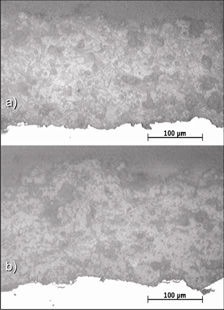
Microstructure of the coating
as-deposited (a) and etched (b)
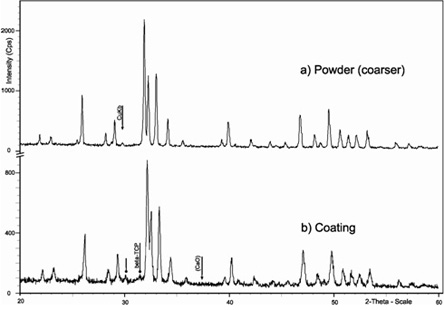
XRD paterns of the
powder (a) and coating (b)
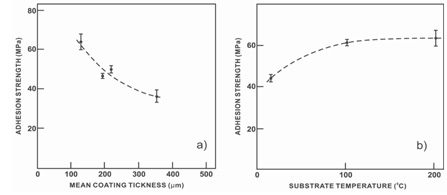
Adhesion of the coating as a function of
a) coating thickness
b) substrate temperature
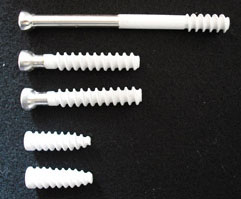
Coated implants
Reviewer's comment on our scientific paper:
"Probably the authors have successfully deposited a very dense, adhesive HA coating with high crystallinity, they should give more evident informations, convincing us that this fantastic work happened."
(Unknown Reviewer)
...Read our answer on this review's comment